Weston in Gordano Manor House

Strictly speaking, Weston has had three manor houses over the centuries.

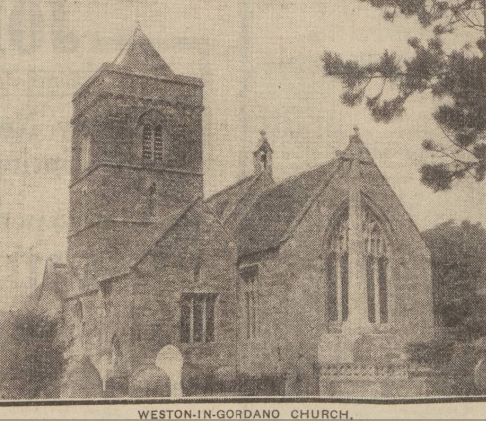
As long ago as the 12th century – about the same time as the earliest part of the parish church was built – there was a moated manorial settlement some 200m south east of the church. This was probably a timber structure, and little remains to be seen, although in the south east corner of the site there is still a small L-shaped pond which may be the remains of the moat. It dries out in summer. The rest of the site has been covered in several feet of fly ash, the waste from the coal-fired powers stations which used to stand in Portishead. It is inhabited by swarms of rabbits which are distinctive because of their dark, almost black, coats: possibly the fly ash, perhaps a genetic variation.

The second manor house site lies about 150m down the lane beside the church, directly behind our house, The Dairy. When the lane was tarmacked in 2004 we found a cobbled surface under the mud, so this was obviously the route from the manor to the church.

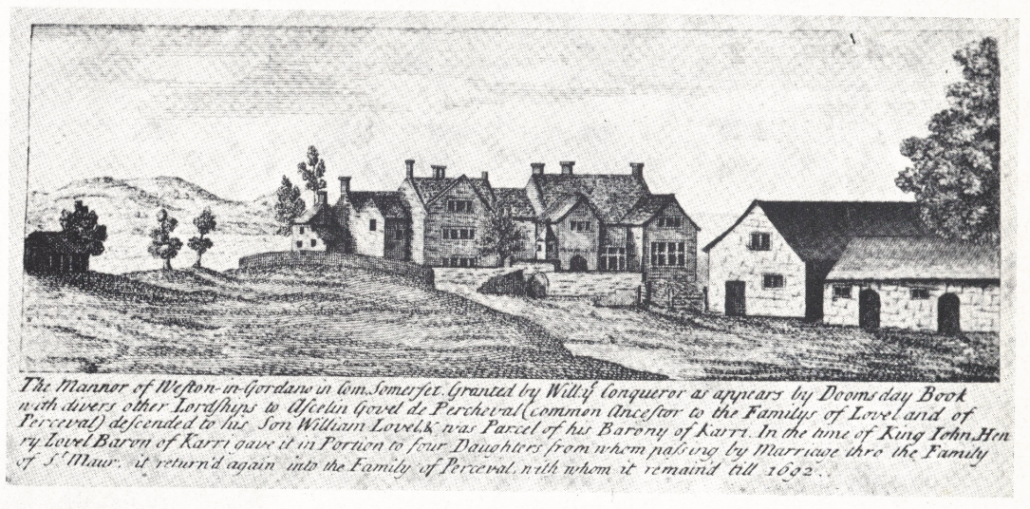
This manor house was built in about 1430 by the Perceval family, lords of the manor of Weston from the 1100s to the 1700s. This is the building shown in the engraving, the original of which is in the Somerset County Archive. It’s unusual in being built so low down in the valley, where you might think there was a risk of flooding, but the valley is very wide and even in the extremes of weather in recent years, this has never been a threat. It has been suggested that what is now the main drainage rhyne was navigable by flat bottomed boats, which might explain its position, but this is speculation.

Today all that is left of the building is a small section of field wall in the south west corner. The lord of the manor at the time backed the wrong side in the English Civil War, so it became a “bit of a ruin that Cromwell knocked about.” His troops burnt and demolished part, but it remained habitable: the engraving is dated 1742, so it was a huge house even then.

After the Restoration, the lord of the manor, Thomas Perceval, who was financially stretched, applied to the King for some reward for his loyalty. All he received was two royal visits to Weston, the cost of which ruined him. The Percevals sold up in 1705 to the son of the lord of Easton in Gordano. In 1714 he died, and the estate was sold to Cann Wilkins, thought to be a Bristol merchant. Wilkins built the third manor house, now known as Weston Lodge, on top of the hill looking down through the woodland to the church and the village.

The manor house of 1430, in its reduced state, remained in use as a farmhouse, but was finally demolished at some point after 1742. But stone is very heavy and transporting it is expensive: look around at the older buildings in our village. It is likely that at least some of them were built of the demolition spoil purloined from the Percevals’ manor house. Many local field walls are built of finely dressed stone which must originally have been prepared, at great expense, for a stately building.

When landscaping our garden, we came across huge quantities of this dressed stone, and much of it has been incorporated into our work. The Percevals’ manor house lives on!

Content kindly provided by David Lewis
Fatal accident at Weston-in-Gordano

Western Daily Press

OCT. 19, 1888

Threshing machine explosion. One dead.

At Mr Perkin’s farm Weston-in-Gordano, yesterday, during some steam threshing operations, the engine boiler burst. The driver William Lodge of Yatton, who was the owner of the threshing machine, was so seriously hurt that he died shortly after. A dog was also killed.

The straw and some corn ricks were entirely consumed. The Clevedon Fire Brigade were promptly on the spot under the command of Sir E. H. Elton. The Superintendent and their efforts were mainly directed to the preservation of some neighbouring ricks in which they were successful. The threshing machine was entirely destroyed. The farm produce was insured.

All transcriptions appearing here have been created exclusively for the website, from the original documents. There are hundreds of articles to process and transcribe, which will take time, so please return to see new content as its added.


Original newspaper scans are provided by the British Newspaper Archive


Dedication of a Lychgate

Western Daily Press

NOV. 30, 1897

Jubilee memorial is dedicated in Weston-in-Gordano

The jubilee memorial in this parish, which look form of a new lychgate at the entrance to the churchyard, was solemnly dedicated on Friday evening by the Venerable the Archdeacon of Bath. The gate is a massive structure of oak, resting on a stone wall on either side, the roof being covered with brown Brose tiles, and is a copy, with a slight alteration, of the fifteenth century one in Middlesex.

All transcriptions appearing here have been created exclusively for the website, from the original documents.

There are hundreds of articles to process and transcribe, which will take time, so please return to see new content as its added.


Original newspaper scans are provided by the British Newspaper Archive


ST. PAUL’S CHURCH, WESTON-IN-GORDANO

Bristol Times and Mirror
SEP. 12, 1908

Dedication of stained glass windows at St.Paul’s Church

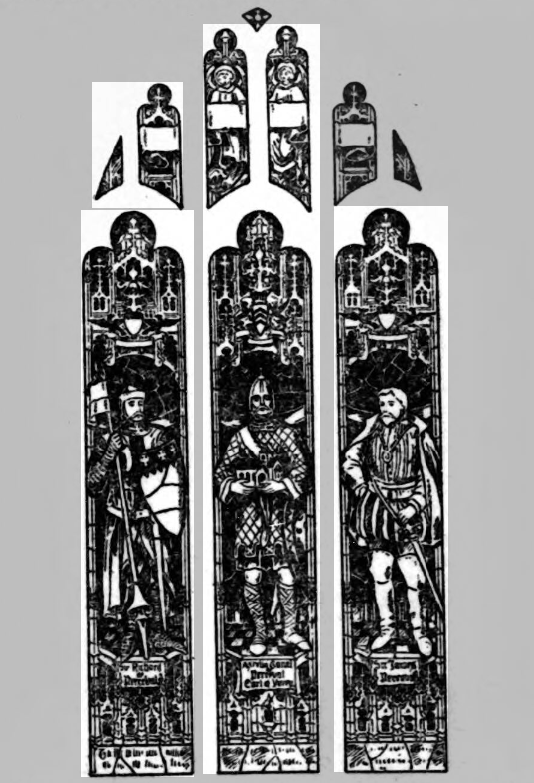
At a special evening service on Friday a stained glass window was dedicated by the Bishop of Grahamstown. The window, which is situated at the west end, consists of three lights with tracery above, and represents three ancestors of the Percevals. In the centre light is Ascelin Gouel de Perceval, Earl of Yvery and founder of the church. He is shown as a Norman Knight in fall armour of the period, holding the model of a Norman church. At his right is Sir Richard de Perceval, a Crusader. He fought with King Richard, Coeur de Lion, in the Holy Wars, wherein he greatly distinguished himself by his bravery. It is recorded that in one of the many hand-to-hand conflicts which marked the close of this campaign he lost an arm, but holding the reins in his teeth he still continued fighting, until his leg was also severed. It is worthy of notice that a crest borne by his present-day descendants is a knight in full armour, minus an arm and a leg. In the right hand light is Sir James Perceval, in a costume of the Henry VIII period.

Beneath each figure is a space recording the names and titles, together with the dates of their respective deaths, A.D. 1119, 1202, and 1550. In the canopy above are the family arms with their supporters, and at the bottom of the window is use following inscription, “To the glory of God and in memory of Ascelin Gouel de Perceval, the founder of this church; James, the re-builder; and Richard, who fought in the Holy Wars. This window is dedicated by their descendants A.D. 1908.”

In the tracery are angels bearing a scrool on which is inscribed the following prayer, adapted from an inscription in Norman French on a monument on the north side, to the memory of Richard Perceval, who died in 1483 —”Blessed Jesu, by Thy Bitter Passion bring their Souls to Thy Salvation.”

The window has been admirably executed by Messrs. Joseph Bell and Son, of 12 College Green, Bristol. It is very rich in colouring, and forms a handsome and fitting memorial to those whom the church owes its origin. The church has just been renovated under the direction of Mr. F. Bligh Bond, F.R.I.B.A. and situated as it is on the main road, midway between Clevedon and Portishead, a visit would well repay anyone interested in ancient architecture.

All transcriptions appearing here have been created exclusively for the website, from the original documents.

There are hundreds of articles to process and transcribe, which will take time, so please return to see new content as its added.

Original newspaper scans are provided by the British Newspaper Archive

English Folk Dances at Clifton

Western Daily Press

FEB. 16, 1920

Sword dance by the Morris dancers of Weston-in-Gordano

The Bristol branch of the English Folk Dance Society, which has been inactive during the war, has resumed its very delightful work, and on Saturday night at the Royal West of England Academy a large company of enthusiasts took part in charming repertoire of the fine old dances which were the vogue hundreds of years ago.

It is interesting to learn that the movement to preserve this phase of old English social life is popular all over the country, and judging from the number and wholehearted enthusiasm of those who took part in the gathering on Saturday night Bristol, is doing its part well.

The local society will hold classes at which the Morris dance as well as country and sword dances will be taught, and the demand for teachers, we understand, is at present beyond the supply. There is scarcely an elementary school in the city where the children do not enjoy their English dance, and many of the secondary schools are following this excellent lead. So far, however, men and boys have not entered into the scheme to any great extent, and most of the dancers on Saturday night were ladies. The programme included some of the most typical of folk dances;

“Helston Ferry, We won’t go home till morning, Black Nag, The Butterfly, The Boatman, Gathering Peascods, Rufty Tufty, Bonnets Blue, Newcastle, If all the world were paper, Galopede, Picking up sticks, Old Mole and Sellengen Round.”

To the lively music of piano and violin the dancers tripped it merrily, deriving stimulating exercise as well enjoyment in full measure. The feature the evening, however, was an exhibition sword dance by the Morris dancers of Weston-in-Gordano. This particular dance belongs traditionally to Kerby Malyard. near Ripon, and unlike the Scottish sword dance it is very intricate and exciting. It is interesting to know that some of the country dances which figured on the programme were taken from old dance book of 1650. Miss Robinson, of The Towers, Sneyd Park, who chairman of the Bristol branch, was the hostess of the evening.

All transcriptions appearing here have been created exclusively for the website, from the original documents.

There are hundreds of articles to process and transcribe, which will take time, so please return to see new content as its added.


Original newspaper scans are provided by the British Newspaper Archive

Somerset Church Fire Mystery

Western Daily Press
FEB. 24, 1934

Police searching for unknown man. Rector’s mother-in-law collapses and dies.
Car dash from Portishead!

Mystery and tragedy are closely linked with the outbreak of fire in Weston-in-Gordano church yesterday which completely destroyed a 17th century screen. A woman is dead as a sequel to the fire and the Somerset police are making inquiries into the report that an unknown man was seen in the church shortly before the outbreak was discovered. The tragedy is in the death of the rector’s mother-in-law Mrs Rose Quartly-Carter who collapsed and died after rushing to Weston-in-Gordano from Portishead to give what assistance she could.
A “Press and Mirror” reporter was told by the rector (the Rev. P. I. Lach-Szyrma), that Mrs Quartly-Carter was 80 years of age and suffered from heart trouble. As soon as she heard of the fire, she ran to catch a train at Portishead station and on arrival at Weston-in-Gordano she collapsed and died.
The rector was also in Portishead with the news of the outbreak reached him and he was fetched from a service in which he was taking part. He rushed to Weston-in-Gordano by car.
The mystery is provided by an unknown man, who was seen by the caretaker Mrs Symes, sitting in the church shortly before the fire was discovered. When Mrs Symes saw him he had his hat on and was singing. Occasionally his singing gave place to incoherent muttering. Mrs Symes who was cleaning the church left the building for a few minutes to return to her house but becoming suspicious of the stranger’s actions went back to the church. It was then that she made the startling discovery that the vestry was in flames and smoke was pouring into the church.
There was no sign of the unknown man. Mrs Symes immediately gave the alarm and later provided the police with the description of the stranger. Portishead fire brigade through their promptness were able to save the church from serious damage and the fire was soon got under control by means of extinguishers and the water carried on the engine.
Damage was done, however, to the belfry, a quantity of cassocks and surplices, bell ropes and books while the screen, which separated the belfry from the nave, was completely destroyed.
Excluding the value of the screen, the rector said that he estimated the amount of the other damage at about £30. The screen, he said, was not part of the present church which dates from the 14th century having been rebuilt on Norman foundations. The screen which dates from 1633 was brought to England from Belgium by a former rector of Weston-in-Gordano and placed in the church about 50 years ago. Mr Lach-Szyrme said he anticipated that it would be possible to hold the services in the church tomorrow as usual.
All transcriptions appearing here have been created exclusively for the website, from the original documents.
There are hundreds of articles to process and transcribe, which will take time, so please return to see new content as its added.
Original newspaper scans are provided by the British Newspaper Archive

Portishead and Weston church fires

Western Daily Press and Bristol Mirror

FEB. 26, 1934

Local people suspect there is some connection

Is there any connection between the mysterious fire at the ancient Weston-in-Gordano Parish Church near Portishead and the recent outbreak which destroyed the church at Weston-Super-Mare?

This is a question which the people of Somerset are asking themselves because of the suspicion in the district that an incendiary was responsible for the fire at Weston-in-Gordano which did damage to the belfry and the vestry.

The rector Rev. P. I. Lach-Szyrma, believes that the fire may have been started in his church deliberately and he is not the only inhabitant of the district who holds that view.

“The police believe the fire was due to an electric light fuse but the fact remains only a few weeks ago the church at Weston-Super-Mare was burned down,” he told a “Press and Mirror” reporter yesterday.

In the evening before his sermon the rector briefly referred to happenings of the past few days and he paid tribute to the work of all who had in anyway helped to fight the fire.

The fire destroyed a 300-year-old screen which separated the belfry from the nave and it was replaced yesterday by match boarding which also screened from view the other damage to the beams of the belfry. This and a pungent odour of burnt wood were the only evidence of the drama that had been enacted in the village during the past few days.

The bell ropes which were also damaged by the fire had been replaced for yesterday’s services and the bells pealed as usual to greet the glorious sunshine of a beautiful morning as though nothing had happened. Even the congregation was no bigger than usual.

Across the road the curtains of the rectory were drawn reminding the visitor that through hurrying to the church from Portishead to give what assistance she could, Mrs R. Quartly-Carter, the rector’s 80-year-old mother-in-law had collapsed and died.

Besides the dramatic chain of events there still exists the unsolved mystery of the man who was seen to behave in such a peculiar manner in the church before the outbreak was discovered.

The man had been described to police as about 50, wearing a light-coloured trilby hat and a light grey overcoat.

Friday’s fire was quickly extinguished by the prompt work of the Portishead fire brigade and the villagers, but further alarm was caused early on Saturday morning by discovery fire had broken out again. It was again discovered by Mrs Symes the caretaker.

As on the previous occasion, the Portishead fire brigade soon had the outbreak under control. It is thought that the beams smouldering through the night with the cause of the second blaze.

All transcriptions appearing here have been created exclusively for the website, from the original documents.

There are hundreds of articles to process and transcribe, which will take time, so please return to see new content as its added.

Original newspaper scans are provided by the British Newspaper Archive


Weston-In-Gordano Church Fire Tragedy

Western Daily Press and Bristol Mirror

FEB. 28, 1934

Mrs Quartly-Carter’s Funeral

“Death from natural causes” was the verdict at the inquest at Weston-in-Gordano or Mrs Rose Harriet Quartly-Carter, mother-in-law of the Rev. Lach-Szyrma, vicar of the parish, living at Avon View, West Hill, Portishead, who collapsed and died after making the journey from her home to Weston-in-Gordano on Friday when a fire was discovered at the church.

Evidence was given that Mrs Quartly-Carter entered a carriage on the train at Portishead and seemed out of breath. On alighting at Weston-in-Gordano she complained of feeling ill.

Mrs Carter was assisted into a car accompanied by Mrs Annie Kitchen of Myrtle Cottage, North Weston and travelled to the rectory where she collapsed on the steps.

Doctor Douglas Bruce of Portishead said he had warned Mrs Carter against sudden exertion or excitement because of the condition of her heart.

All transcriptions appearing here have been created exclusively for the website, from the original documents.

There are hundreds of articles to process and transcribe, which will take time, so please return to see new content as its added.


Original newspaper scans are provided by the British Newspaper Archive

PORTISHEAD WOMAN 100 TO-DAY

Western Daily Press
NOV.18, 1938

Never “Believed” in Doctors

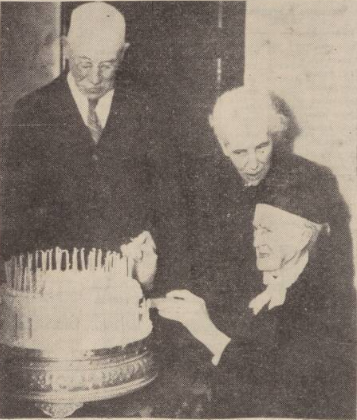
Mrs MARY ANN TRIPP, of Kew Villas, Bristol Road, Portishead, today becomes centenarian. In many ways she is a remarkable old lady and never “”believed”” in doctors until this year, when she had slight fall. Before then she had never received medical attention. She is the daughter of the late Mr and Mrs Wyatt, and was born in the neighbouring hamlet of North Weston.
She was christened at Weston-in- Gordano Parish Church. married at St. Peter’s Church, Portishead, and has been a widow for just over 40 years.
45 Descendants. She is now living with her son. Mr Edwin Tripp (who is 72), a daughter, and a daughter-in-law, the combined ages of them ail being 311 years. Her descendants are six children. 19 grandchildren, and 20 great-grandchildren. Until a few years ago she was an enthusiastic gardener.
Apart from slightly impaired hearing, she has full use of all her faculties, being able to read and sew without glasses (she can even thread her own needle), and is able to walk about unaided.
All transcriptions appearing here have been created exclusively for the website, from the original documents.
There are hundreds of articles to process and transcribe, which will take time, so please return to see new content as its added.
Original newspaper scans are provided by the British Newspaper Archive

One legged man at Weston Lodge

Birmingham Daily Post

NOV. 10, 1954

One legged man enters Weston Lodge to reclaim false leg.

Eighteen months after a one-legged man had left his spare false leg with his landlady in lieu of rent, it was stated at Somerset Quarter Sessions yesterday, he re-entered the house to reclaim the limb because the false leg he was wearing needed repair. He did not find the limb, but was found himself, in a bedroom, by one of the tenants and the police were called.

The man, Howard James Challenger (22), a steel erector of Brockley Camp, Brockley near Bristol, limped out of court a free man yesterday having been acquitted by a jury on a charge of breaking and entering Weston Lodge, Weston-in-Gordano, with intent to steal.

He had pleaded not guilty. Challenger said that no one heard his knock, so he went In and had a look round. He had no intention of stealing and had hoped to settle his rent debt of a few pounds with 5s. weekly instalments in return for the leg.

All transcriptions appearing here have been created exclusively for the website, from the original documents.

There are hundreds of articles to process and transcribe, which will take time, so please return to see new content as its added.

Original newspaper scans are provided by the British Newspaper Archive